Research
Read 12 VisualHFT articles covering research, order book microstructure, real-time flow analytics, and trading architecture.
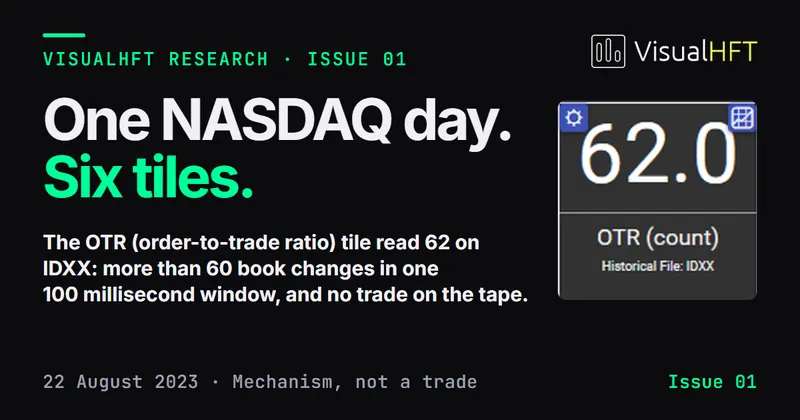
VisualHFT Research, Issue 01: One NASDAQ day, six tiles
Issue 01 of VisualHFT Research, as a PDF: two settings of the LOB Imbalance tile compared on ten liquid NASDAQ symbols, a guide to reading the captures, and a map of the fourteen spreads.
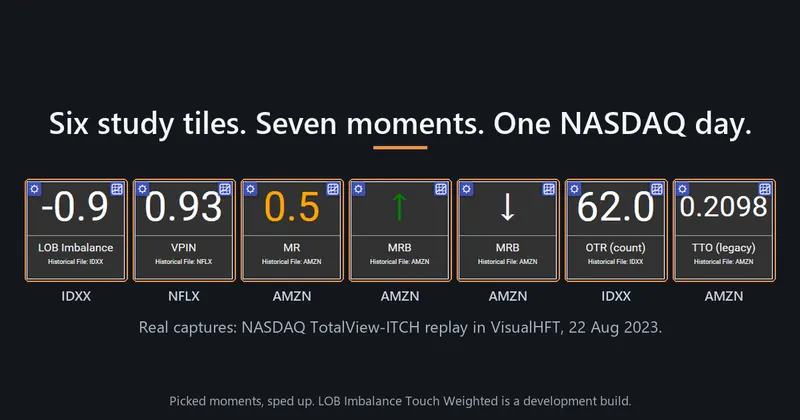
Six Study Tiles, One NASDAQ Day: The Theory, the Screen, and What the Data Supports
We replayed a full NASDAQ TotalView-ITCH trading day through VisualHFT, captured each study tile doing what its research says it should, walked through every pause, and tested each tile against a free rule on symbols held out from the design.
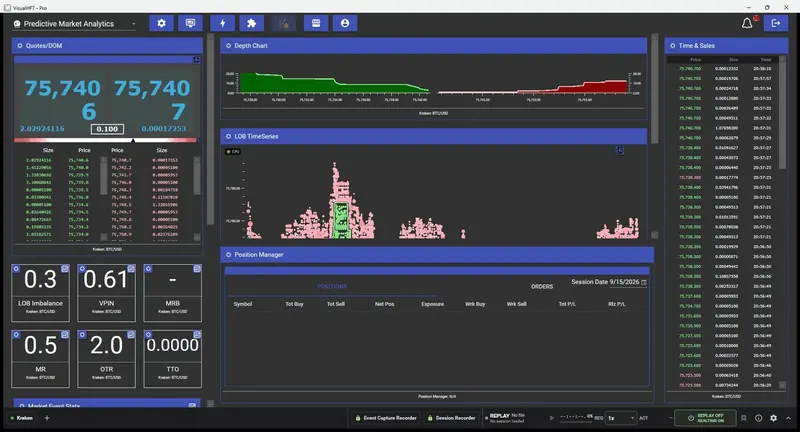
Order-book imbalance and the next ten seconds
We recorded VisualHFT against live Kraken BTC/USD twice, measured whether each study tile said anything about the next price move, and then spent longer trying to break the answer than we spent finding it.
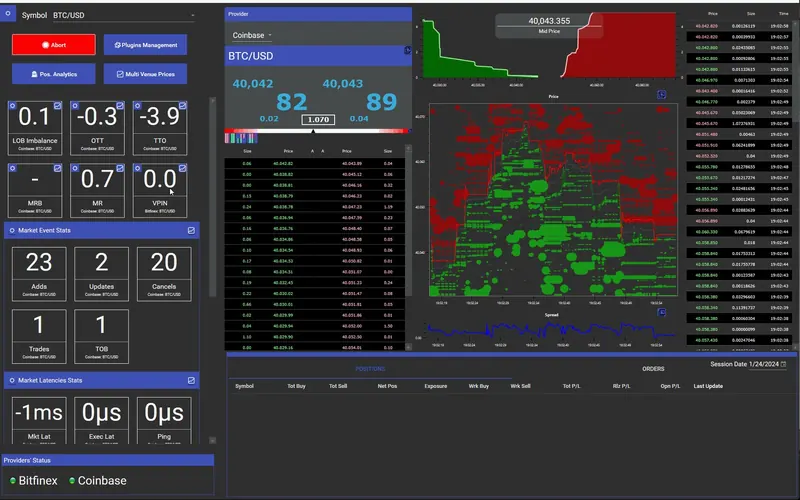
The Six-Signal Microstructure Cascade: How VisualHFT Instruments the Full Second Before the Print
Cancel-side asymmetry, refresh-latency p95 widening, VPIN elevation, multi-level LOB shift, spread widening, then the print. Each signal has a name, a plugin, and a GIF. Here is the full cascade as VisualHFT instruments it in real time.
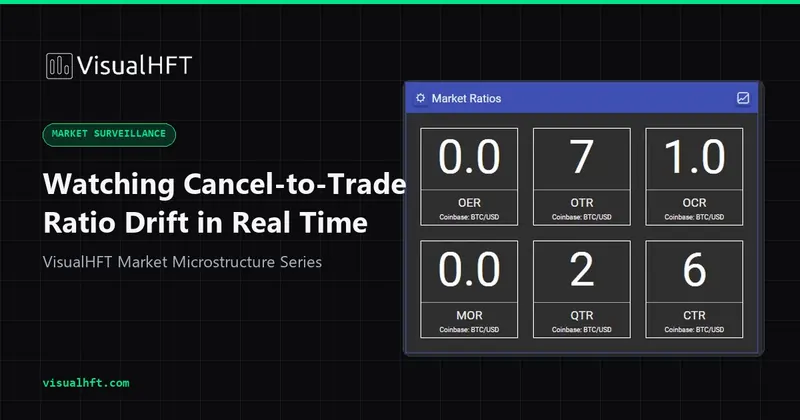
Watching Cancel-to-Trade Ratio Drift in Real Time: What Batch Reports Miss Before the Flag Arrives
A 14:1 daily mean hides 3-minute intraday windows at 60:1 where messaging-fee tiers trip and exchange surveillance queues flag quote-stuffing-adjacent activity. Here is why CTR at sub-second cadence, segmented by side and depth, reads as a different metric than its end-of-day aggregate, and how VisualHFT renders it live.
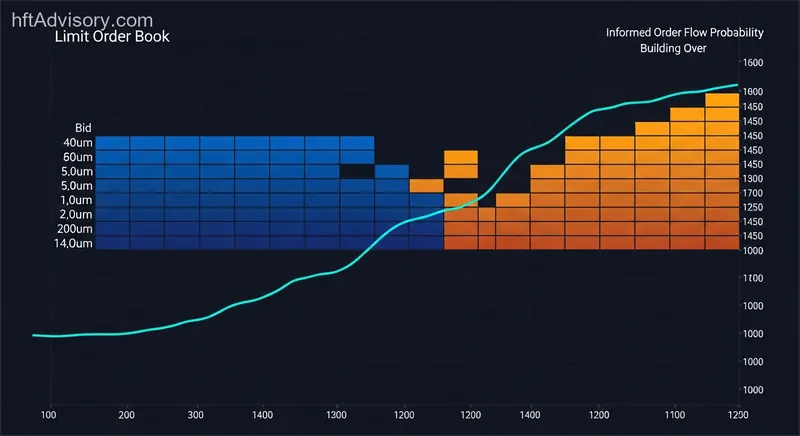
VPIN and Real-Time Order Toxicity: What Your Execution Stack Cannot See Before the Fill
VPIN and LOB imbalance signal informed order flow before the price print moves. Here is why your execution stack is blind to it — and how VisualHFT changes that with real-time, auditable microstructure analytics.

Trade Surveillance in Modern Financial Markets
As financial markets continue to evolve, the role of sophisticated trade surveillance systems like VisualHFT becomes increasingly crucial. By integrating advanced technological capabilities with a deep understanding of market dynamics, VisualHFT stands at the forefront of efforts to maintain transparency, ensure compliance, and uphold the integrity of the financial markets.

Volume-Synchronized Probability of Informed Trading (VPIN)
This article explores the Volume-Synchronized Probability of Informed Trading (VPIN), a metric enhancing market analysis by measuring trade volume imbalances. Developed by Easley, López de Prado, and O'Hara, it's crucial for detecting informed trading and market sentiment, particularly in volatile markets. VPIN's significance is highlighted in studies like the 2010 Flash Crash analysis. Its real-time application in market surveillance and forecasting volatility, especially in high-frequency trading, marks a significant advancement in financial analytics.

The Art and Science of Market Resilience in Trading Strategies
Market Resilience (MR) has emerged as a pivotal metric in the field of trading analytics platforms, offering a real-time gauge of market stability following significant trades. This metric is particularly relevant for traders and financial analysts who rely on real-time trading analytics to make swift, informed decisions in a dynamic market environment.

Enhancing Algorithmic Trading: Tools for Real-Time Strategy and Slippage Reduction
Understanding the intricacies of algorithmic trading is essential for traders in today’s digital age. From the significance of the Limit Order Book to the influence of trading venues, each aspect plays a crucial role in trading outcomes. Tools like VisualHFT offer insights and real-time monitoring capabilities, highlighting the importance of staying informed and adapting to the evolving landscape. As trading continues to advance, embracing these insights and tools will be vital for success in the market.

Leveraging Limit Order Book Imbalances for Profitable Trading: A Deep Dive into Recent Research and Practical Tools
In this article, we’ll explore these questions in depth. We’ll dive into recent academic research that has investigated the potential of LOB imbalances as a trading signal. We’ll dissect these studies, understanding their methodologies, dissecting their results, and drawing out their conclusions. Our journey will take us through the intricacies of trade arrival dynamics, the price impact of order book events, and the predictive power of queue imbalances.
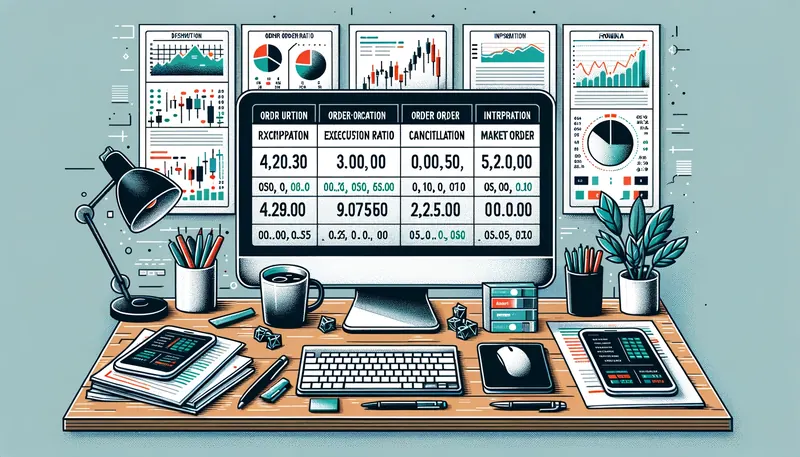
Decoding the Cancellation-to-Trade Ratio: Rethinking its Role in High-Frequency Trading Analysis
The cancellation-to-trade ratio has been a longstanding metric for assessing High-Frequency Trading (HFT) activities in financial markets. Traditionally, this ratio was thought to reflect the frequency of order placement and cancellation typical of HFT strategies, particularly in relation to liquidity provision. Recent research, however, challenges this view, suggesting a more complex relationship between HFT activities and the cancellation-to-trade ratio.