1,200 stars on the public VisualHFT repository
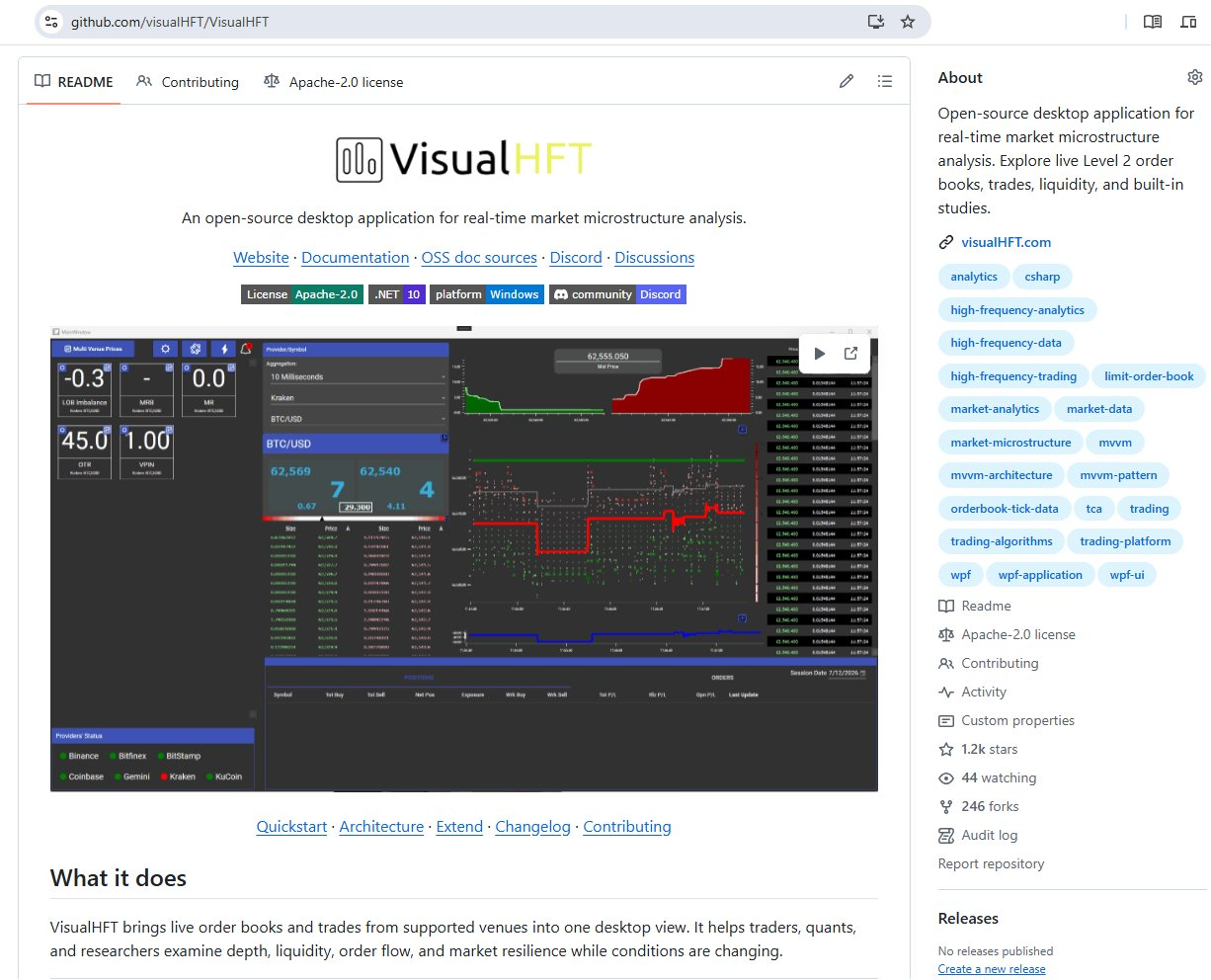
The public VisualHFT repository has reached 1,200 stars.
Thank you to everyone who starred it.
The repository is the open-source desktop application for real-time market microstructure analysis. It runs on Windows and targets .NET 10. It brings live order books and trades from supported venues into one desktop view, so traders, quants, and researchers can examine depth, liquidity, order flow, and market resilience while conditions are changing. The license is Apache-2.0.
The code is here: github.com/visualHFT/VisualHFT.
The README has the setup steps. The build needs that repository and the VisualHFT OxyPlot fork side by side. The same page links to the documentation, Discord, and GitHub Discussions.
Related reading
Inside the VisualHFT Private Beta: From Market Data to Execution Decisions
First published on July 22, 2026, this product deep dive follows the complete workflow from raw market data and pre-trade analysis through event replay and execution diagnostics.
Enhancing Algorithmic Trading: Tools for Real-Time Strategy and Slippage Reduction
Understanding the intricacies of algorithmic trading is essential for traders in today’s digital age. From the significance of the Limit Order Book to the influence of trading venues, each aspect plays a crucial role in trading outcomes. Tools like VisualHFT offer insights and real-time monitoring capabilities, highlighting the importance of staying informed and adapting to the evolving landscape. As trading continues to advance, embracing these insights and tools will be vital for success in the market.
Leveraging Limit Order Book Imbalances for Profitable Trading: A Deep Dive into Recent Research and Practical Tools
In this article, we’ll explore these questions in depth. We’ll dive into recent academic research that has investigated the potential of LOB imbalances as a trading signal. We’ll dissect these studies, understanding their methodologies, dissecting their results, and drawing out their conclusions. Our journey will take us through the intricacies of trade arrival dynamics, the price impact of order book events, and the predictive power of queue imbalances.