Decoding the Cancellation-to-Trade Ratio: Rethinking its Role in High-Frequency Trading Analysis

The cancellation-to-trade ratio has been a longstanding metric for assessing High-Frequency Trading (HFT) activities in financial markets. Traditionally, this ratio was thought to reflect the frequency of order placement and cancellation typical of HFT strategies, particularly in relation to liquidity provision. Recent research, however, challenges this view, suggesting a more complex relationship between HFT activities and the cancellation-to-trade ratio.
The Traditional Interpretation of the Cancellation-to-Trade Ratio
Historically, a high cancellation-to-trade ratio was synonymous with intense HFT activity. HFTs, known for their rapid order turnover, were believed to significantly influence market liquidity through their high-frequency order placements, many of which were rapidly cancelled.
Emerging Contradictions and New Insights
Contrary to this traditional belief, recent studies have shown an inverse relationship between HFT liquidity provision and the cancellation-to-trade ratio. Specifically, stocks with greater liquidity provision by HFTs often exhibit lower cancellation-to-trade ratios. This finding implies a more intricate interplay between HFT activities and market dynamics than previously thought.
The Impact of Tick Size and Adverse Selection Risk
The observed inverse relationship can be explained by considering two key factors: tick size and adverse selection risk. Stocks with smaller tick sizes and higher adverse selection risks tend to have a lower proportion of liquidity supplied by HFTs, yet display a higher cancellation-to-trade ratio.
- Influence of Tick Size: A decrease in tick size correlates with more frequent order cancellations by HFTs. In markets with smaller tick sizes, HFTs are more prone to adjust their positions in response to competitive pressures, leading to a higher cancellation-to-trade ratio.
- Adverse Selection Risk: This risk, characterized by the frequency of value jumps relative to non-HFT order arrivals, also influences the cancellation-to-trade ratio. Increased adverse selection risk leads to more order cancellations and a decrease in liquidity provision by HFTs.
Revisiting Flickering Quotes
The phenomenon of flickering quotes, often attributed to new market information, is also revisited in light of these findings. It’s suggested that HFTs might cancel orders not only in response to new information but also as a strategic reaction to market conditions, contributing to the occurrence of flickering quotes.
The Role of VisualHFT in Analyzing HFT Activities
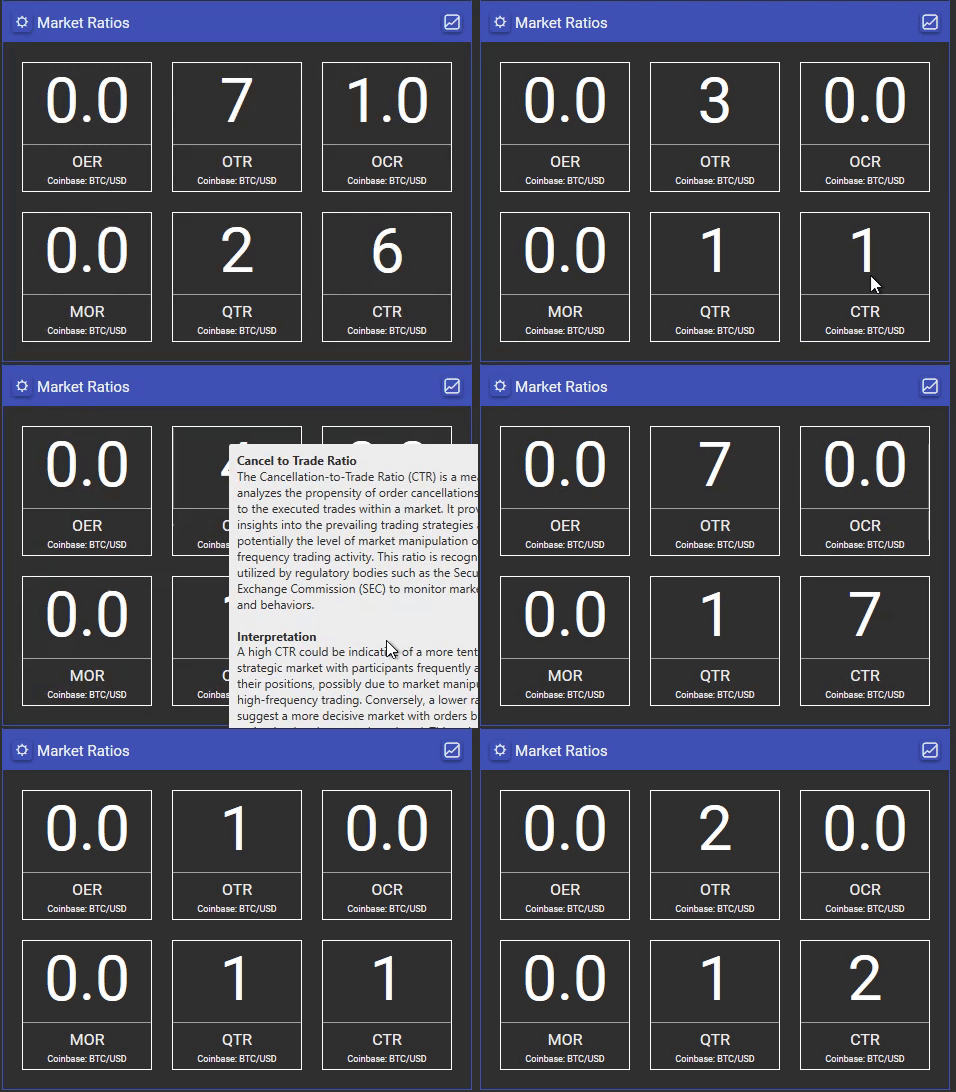
VisualHFT, a sophisticated analytics tool, offers real-time insights into HFT activities, including the cancellation-to-trade ratio. It provides a comprehensive view of market dynamics, enabling traders and analysts to:
- Monitor Real-time Data: VisualHFT tracks HFT patterns, offering immediate data on cancellation-to-trade ratios across different stocks and markets.
- Compare Across Markets: Users can compare cancellation-to-trade ratios in different market conditions, assessing the impact of factors like tick size and adverse selection risk.
- Advanced Analytics: VisualHFT’s analytics tools help interpret complex data, providing a clearer understanding of HFT strategies and their market implications.
Conclusion: Towards a Holistic Understanding
The reevaluation of the cancellation-to-trade ratio, in light of new research and tools like VisualHFT, underscores the need for a comprehensive approach to analyzing HFT activities. This metric, influenced by various market conditions, requires a nuanced interpretation, which tools like VisualHFT can facilitate.
Reference
This analysis is informed by the findings in the paper “Who Supplies Liquidity, and When?” which presents an in-depth examination of HFT activities and their intricate effects on financial market dynamics. The paper challenges traditional interpretations and offers new perspectives on key metrics in the world of high-frequency trading.
Related reading
Enhancing Algorithmic Trading: Tools for Real-Time Strategy and Slippage Reduction
Understanding the intricacies of algorithmic trading is essential for traders in today’s digital age. From the significance of the Limit Order Book to the influence of trading venues, each aspect plays a crucial role in trading outcomes. Tools like VisualHFT offer insights and real-time monitoring capabilities, highlighting the importance of staying informed and adapting to the evolving landscape. As trading continues to advance, embracing these insights and tools will be vital for success in the market.
Leveraging Limit Order Book Imbalances for Profitable Trading: A Deep Dive into Recent Research and Practical Tools
In this article, we’ll explore these questions in depth. We’ll dive into recent academic research that has investigated the potential of LOB imbalances as a trading signal. We’ll dissect these studies, understanding their methodologies, dissecting their results, and drawing out their conclusions. Our journey will take us through the intricacies of trade arrival dynamics, the price impact of order book events, and the predictive power of queue imbalances.
Volume-Synchronized Probability of Informed Trading (VPIN)
This article explores the Volume-Synchronized Probability of Informed Trading (VPIN), a metric enhancing market analysis by measuring trade volume imbalances. Developed by Easley, López de Prado, and O'Hara, it's crucial for detecting informed trading and market sentiment, particularly in volatile markets. VPIN's significance is highlighted in studies like the 2010 Flash Crash analysis. Its real-time application in market surveillance and forecasting volatility, especially in high-frequency trading, marks a significant advancement in financial analytics.